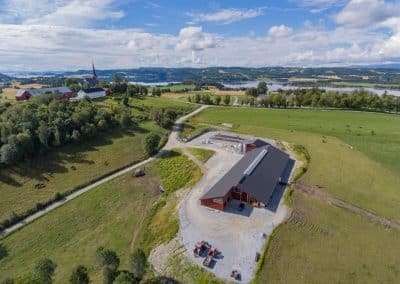
We are constantly working to reduce greenhouse gases here at the Zero Emission Farm on Mære. One of the experiments carried out in this field concerns biochar and animal manure. We asked ourselves: Can we make a cover of biochar in the livestock manure warehouse and thus reduce emissions of greenhouse gases?
The experiments carried out by NIBIO here on Mære show that biochar significantly reduced methane emissions by 28 %, but only when it was kept artificially floating on the surface using a floating membrane. So the answer is to some extent yes: Under specific conditions, biochar can reduce greenhouse gases.
See more about the experiment in this film:
Facts about the experiment:
The experiment was carried out by Adam o'Toole in NIBIO and is one of the activities in RESTORE where we look at different ways of handling organic waste. Here, Mære collaborates with SINTEF, NGI and NIBIO. Please note that this film was recorded while the experiment was ongoing in 2022 and that Adam no longer works at NIBIO. We wish him the best of luck in new projects in his home country of Australia!
The trial in short and text version v/ researcher Adam o'Toole:
In the RESTORE project, NIBIO has tested various setups with biochar (made from pine) as a floating cover material for the reduction of methane from pig manure over a 75-day period in the summer of 2022. Biochar significantly reduced methane emissions by 28%, but only when kept artificially floating on the surface using a liquid membrane. In contrast to a previous study from abroad, we did not find in our study that biochar as a bottom line led to additional methane emissions. We also found that CO2 emissions were significantly reduced with the biochar filter. N2O emissions were minimal and not significant between treatments. The next step will be to clarify whether a biochar methane filter can be optimized so that it also reduces NH3 emissions, which is also problematic with livestock manure. It is a question that NIBIO is taking forward in a new project "Agricascade" which includes Trondheim biocoal producer JordPro AS.
You can read the research report in its entirety here: https://hdl.handle.net/11250/3083864