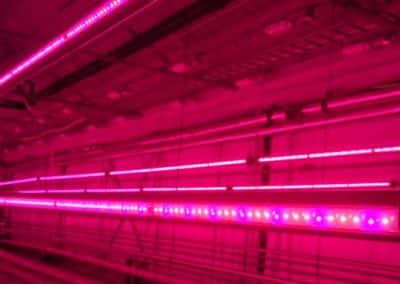
In most buildings there is some form of vapor lamps, fluorescent tubes or halogen, and even if there is good light output from them, LED has gradually become so much better. Replacing light fixtures from old types to modern LED can save about 50% of energy.
New fixtures are often significantly more expensive than traditional fixtures, but this will usually pay for itself in savings in consumption. At Mære, the dairy barn has been switched to LED fixtures. If there are fixtures with fluorescent tubes, only the tubes and teeth can be replaced and it will be cheaper. In the pig barn at Mære, the old fixtures have been switched from fluorescent tubes to LEDs. The savings are 13-14,000 kWh/per year in each of the barns. Below you can see the calculation before and after.

The lifespan is often stated as 25,000-50,000 hours or more. This may sound like a lot, but if the light is on for 3,000 hours per year, that's 30,000 hours in 10 years. Many of the LED installations cannot have the light source replaced, but the entire fixture must be replaced if it goes out.
Another possibility with LED is different control of the light. With new light control, increased production can be achieved in dairy barns. Research is being conducted on day lengths, light levels and color composition.
Learn more about lighting in livestock rooms
Proper lighting in the barn improves animal welfare and can increase milk production.