The lamp type that has so far dominated as grow lights are high-pressure sodium lamps, abbreviated HPS or SON-T. These are relatively affordable lamps with a good light spectrum and good light output. There has long been talk of replacing them with LED luminaires that have an even higher light output, but they have had high prices and there has been some uncertainty about the quality and durability of the luminaires. Another question has been the climate for plant growth under LED. Especially the fact that LEDs have less radiant heat, with the risk of lower leaf temperature and too high humidity. Now we see that more people are switching to LED both in new construction and replacements in existing facilities.
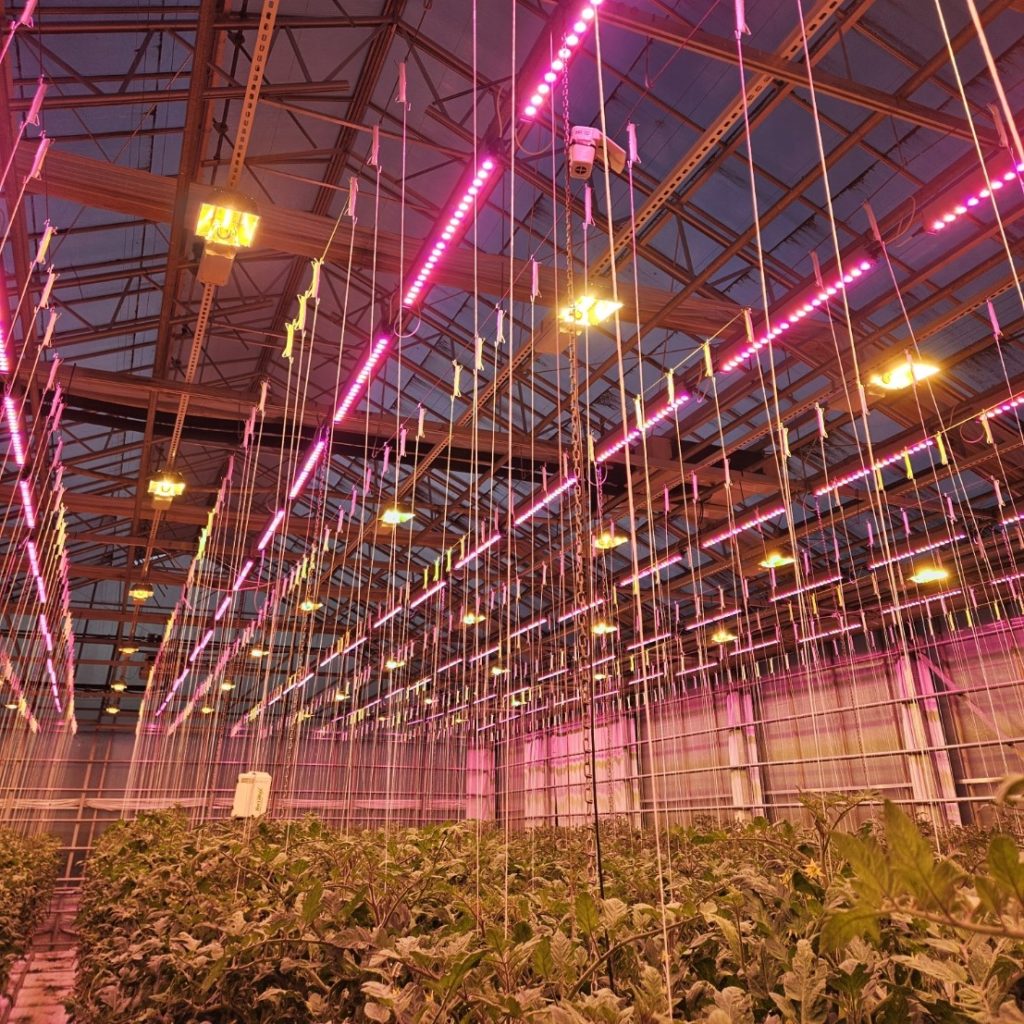
At Mære, we have gradually switched to LED over the past 6-7 years. The first time in 2018 when we installed LED lights between the rows of tomatoes, then as hybrid lights with 50% LED and 50% HPS in the pot department, and now most recently in November 2023, two out of three rows of lights at the top of the tomato department were changed to LED, while a number of HPS were retained .
As mentioned, the light yield and efficiency are a good deal higher with LEDs. In plant cultivation, we measure light in a spectrum where photosynthesis is efficient and we call it photosynthetically active radiation PAR (400-700 nm). We use the measurement unit micromole (µmol) and divide it per watt (µmol/W), to say something about the efficiency of the light source in relation to power consumption. HPS lamps are not bad 1.7-1.9 µmol/W, but LED is better 3.0-3.5 µmol/W.
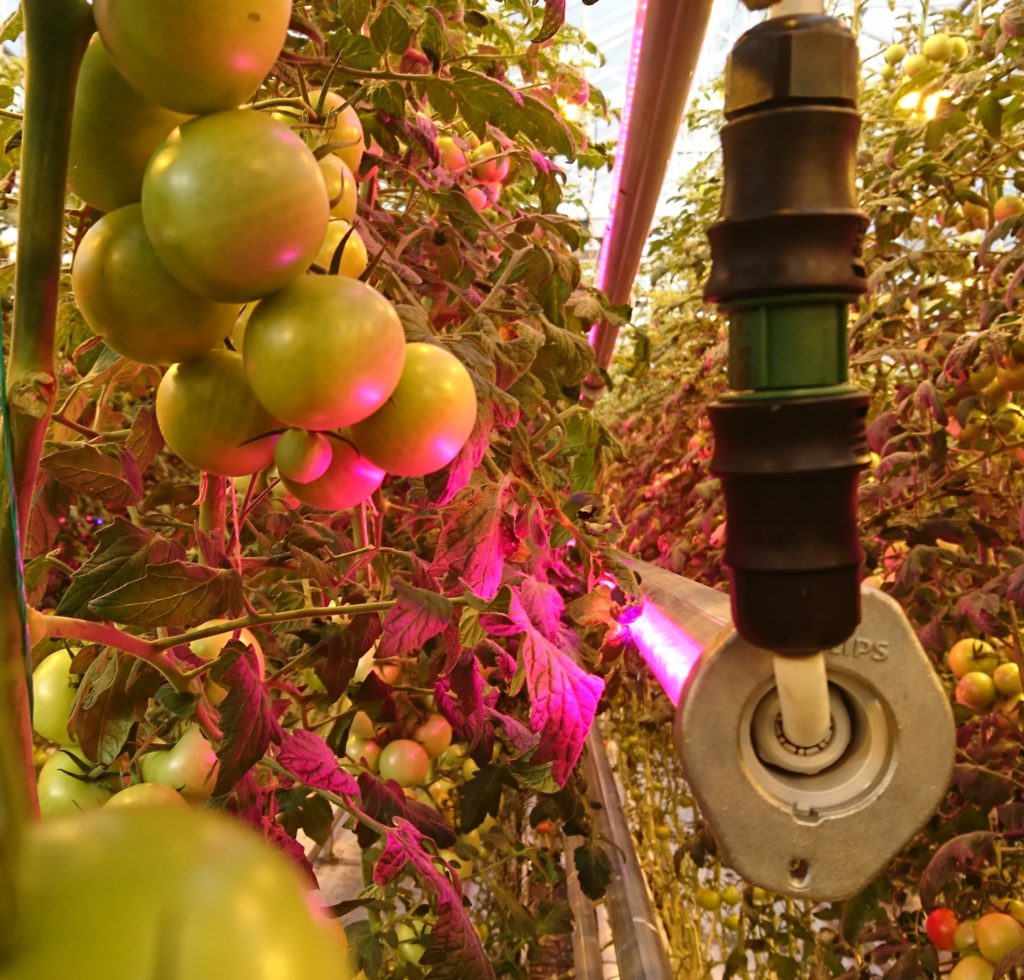
Our first LED installation was so-called intermediate light. There were two rows of lights down in the tomato plants approx. 1.2-1.5 m above the ground. 180 luminaires of 100W each are installed on half the area (18 kW in total). We have registered 15-20% increased yield on that side. Somewhat due to extra energy, but also due to placement down in the plants.
The light in the ceiling in the tomato department was changed in November 2023, when 2/3 of the light was replaced with LED. HPS was installed before 263 kW. After replacement, the output was 166 kW with roughly the same light level of 450-470 µmol/m2. The savings on electricity consumption for 4,200 hours will be in excess of 400,000 kWh. Here we do not have data from the entire season yet.
It is a challenge to keep the temperature and humidity at the right level. Some of the gain can be lost because more heat must be supplied via the heating pipes. We also learned that the old HPS lamps are important to have with you when it's cold outside so that the plants don't get cold at the top.
More info
Here are some good considerations about light quality https://www.youtube.com/watch?v=kUpEQ4kU148